2010年12月8日水曜日

坂茂の仕事

(English follows after Japanese)

 再び建築の話題です。夏頃買ってそのままになっていた坂茂という建築家の『Voluntary Architects' Network 建築を作る。人を作る。ールワンダからハイチへー』という本を読みました。坂氏の作品の中でも、紛争・自然災害への解決策として作られたものがまとめられた本です。

 初めて坂氏の建築を知り、そしてとても心に強くの刻まれたのは、阪神・淡路大震災で焼失した鷹取教会のために作られた紙の教会でした。連日ニュースで流れる避難所や仮設住宅が、雨風をしのげるだけでもありがたいと思うべき、と言わんばかりものばかりだった中、紙管で囲まれたシンプルな紙の教会は、人々の精神のよりどころである教会という場所であることからも大変シンボリックで、いかなる時にも美しく機能的なものの必要性について考えさせられるものでした。

 この教会は、10年経って同じように震災に見舞われた台湾に移築されました。この、よきものに敏感でいる精神が受け継がれていく様子からも、坂氏のプロジェクトはいつも私の関心事の一つでした。その後も、坂氏と彼が教えていた大学の研究室は、津波に襲われたスリランカ、地震の被害を受けたハイチや中国でも同じような復興支援の建築に携わっています。この本には、その実例と現地で使われた素材、そしてもちろん復興支援以外の建造物についてのデザイン面についての分析が記されています。

 はじめに、本の中では彼が「建築家が、弁護士や医者のように弱者のために働けないことを知って後悔した。」という言ったエピソードが書かれています。ここが、彼の出発点であり、彼を今日まで引っ張ってきた力なのだということが、後のインタビューなどを読んでも分かります。また、ドイツのGestalten TVというpodcastでも彼のインタビューを見たのですが、「デザインは社会の問題を解決すること、それが目的だ。」と全く迷いのない口調で言っていたことも同時に思い出しました。

 先日の塚本由晴氏の「ふるまい学」の考え方と同様、建築の専門外である私がこのような「世界との対峙の仕方」に強く心惹かれるのは、建築の持つ力に不思議な共通点があるからのような気もします。機能的、美的であることの重要さはもちろんのこと、私たちが世界のありようを感知し、理解する知性のヒントが建築にはたくさん隠されているような気がします。

The works of Shigeru Ban

The story about architecture again. I have just read the book called "Voluntary Architects' Network" by one of the Japanese architects, Shigeru Ban, which I had bought this summer and had left for a long time. This is about focusing on his projects making shelters for the people where attacked and suffered by natural disasters or wars.

The shelter I first seen was the "Paper Church". It is unforgettable. It was a church made by paper poles for Takatori Church, which burned down in the earthquake, in 1995, in Hanshin (Western) area, in Japan. I remember I have been so upset to see the news on TV that the shelters and prefabs accommodations for the refugees. They looked so ugly, just like saying "You should appreciate that it could avoid rain and wind, right?". Furthermore, they never seemed to be thought of comfort and peace of mind for those who lost their houses, friends and family. So this church reminded me of importance of being surrounded by beautiful and functional things in such difficult situations. It could have the symbolic power that made people heal and comfort would have been so enormous as it is a church. After ten years, this "Paper church" moved and rebuilt in Taiwan where also big earthquake attacked. From those stories that he has been trying to be acutely sensitive for helping people 's life from architectural wisdom, I have been interested in his projects. After the Earthquake in Hanshin-Awaji in 1995, in Japan, he and his lab students has been energetically tackling with creating the shelters in Suri Lanka, where massive tsunami attacked, or China and Haiti where they experienced severe damage by earthquakes. In this book, it tells mainly about those case studies and the materials they used, and also the analysis of other architectures by Mr. Ban.

In the first of this book, Mr. Ban said, "I realized that most lawyers and doctors, excluding limited number of them who worked only to make money, were constantly working for the marginalized". Soon I started to feel tremendous respect for those professionals and a slight regret in choosing to become an architect" in the interview. I found that this would be his starting point to engage with these projects and also the driving force to keep overcoming the difficulties. I also have seen that he remarked the similar philosophy in his work in the interview of him, in the German podcast called Gestalten TV as "Design is for me problem solving method."

I'm not an expert and even I have never been taught architecture in my life. However, the notions of architectures inspired me because they tell a lot about how to encounter the world around us. I felt the same when I listened to the idea of "Behaviology" by Yoshiharu Tsukamoto, the another Japanese architect. That means, architecture tells us not only the importance of function, aesthetics but also the intellects how to be aware of how our surroundings (both nature and manmade) exist, and understand them more deeply.

2010年11月20日土曜日

窓のふるまい学

(English follows after Japanese)

 金曜日の夜、恵比寿へ「窓のふるまい学 Behavior-ology の可能性」というレクチャーを聞きにいきました。建築家の塚本由晴氏と東京工業大学塚本研究室による『Window Scape 窓のふるまい学』という本の刊行を機に行われたものです。塚本氏は私が最も好きな日本の建築家の一人であります。今年の一月、東京アートポイント計画のレクチャーでもちらっと触れていた「ふるまい学=Behaviorology」(「ふるまいから見る建築と都市」をご参照下さい。)について、窓という要素から読み解いたフィールドワークを元にお話しされました。

 まずは、建築史における窓扱われ方や、窓が地域の特性に縛られる不自由な部分などについて話されました。その後、建築の単なる構成要素を越えた"窓"の範囲は何か、陽の光、木漏れ日の移動、なども窓のあり方として拡張し、人々の経験や生態学の中で窓がどのように存在しているかについて話が広がりました。私は、塚本氏がこのように機能や目的、美的要素などだけでない建築の経験という視点から建築を捉える感性にとても共感を抱いてきました。その切り取り方は、建築の専門家ではない私にもとてもリアリティを感じさせます。中でも、マドリードのとある広場のエピソードは、塚本氏の視点を如実に表したものでした。その広場は車道に面しておらず、人々の話し声や生活の音が周りの壁にバウンドして広場に満ちているような心地よい空間だったそうです。同じマドリードでも全面ガラス張りの建物の、見下ろされているような威圧感に対し、この広場に面した建物は窓と壁の分量がだいたい同じ、というのも心理的に大きく違ったそうです。

 このような観点から世界の窓を探訪し、それらがどのように私たちの生活や社会の中で「生きている」かを探ったのがこの『Window Scape 窓のふるまい学』という本です。窓の外と中からの写真、寸法も詳細に記されています。塚本氏によると、言葉の通じない国では身振り手振りで「その窓、とってもいい!(と、まず窓を褒め)オレを、中に、いれて!」とお願いして見せてもらったところもあるとのこと。このエピソードは会場の笑いをさらっていました。実は私はまだぱらぱらとしか見ていないのですが、それだけでも没頭の予感を感じさせるとても魅力的な本です。個人的には窓だけでなく、柱や屋根、さらには社会的な建物、例えば博物館、美術館、病院、工場、ゴミ処理場・・・などにもその研究の幅を広げてほしい!と思っています。

"the Behaviology of windows"

On the friday night, I've been to Ebisu to listen to the lecture called "Behaviour-ology of the Window: Potential of Behaviour-logy" by my favourite Japanese architect, Yoshiharu Tsukamoto and his university lab members. They have just published the book called "Window Scape", which focused on how windows have "behaved" in the architecture around the world. This January, I had also been to listen to his lecture that he was proposing the idea of "Behaviourology" (he made this word that means to search into how things and human beings behave in environment.), so I was excited to expect that his idea would have been expanded and deepen in this book. That night, he talked about architecture from interpretation of the element of windows from the field works from Asia to Europe in this book.

Firstly, he talked about how windows worked and behaved in the surrounded landscape, climate, or people's life in our history. There is one function for windows that they adjust the environment to allow people the comfortable life like taking winds in or shut them out. However, there are limitations that windows are bounded by the environment. Then he told his opinion that windows would be more than just the element and function of the architecture. He referred to the house designed by Louise Kahn as the example of introduction to understand how windows works in architecture. He mentioned the examples such as sunlight or swinging shadow made by woods through the window also offer meanings, and said window would have significant roles to people's experience in the architecture and ecology in the society. I do like how he translates how architectures works in society not only functionally or aesthetically. It gives me some realities in life. I have not an expert of architecture, but as a human being living in this contemporary society, we could not avoid thinking about architecture like where you live, work or amuse. The more, Mr. Tsukamoto always gives me the hints to think about it from his professional point of view and interpretation that even the novice could understand. For example, he mentioned a patio in Madrid. It was surrounded only by the buildings and not faced to the wide road. He said that he felt it was so cosy place. There, people's voice and sound have bound against the walls and the sound filled in the patio softly. He said it was totally different from experience that buildings of glass facade surrounded him. It gave him some coercive atmosphere like being watched down above.

Mr. Tsukamoto and his students have been to many places to observed the windows to see how they "live" in our lives. Then they classified and analysed them from several point of views. In that book, there are photos from outside and inside. Precise sketches and scales are also written. By Mr. Tsukamoto, during field works, they even have been to the countries where they did not understand the languages. The tips were, by Mr. Tsukamoto, making gestures, they told the owners "The window is so cool! (to praise it the first, this is the point), so let us in to look inside!" People at the lecture all bursted into laugh then.

To be honest, I have just skimmed the book yet. Though, I feel there were something so exciting in this book. From my personal interests, I would like to see the further research not only windows, but pillars, roofs. And more, I would like them to expend the research of this architectural behaviology to such as social buildings like museums, art galleries, hospitals, factories, rubbish plants. They must show us the ecological meanings of the architecture.


2010年9月5日日曜日

あいちトリエンナーレ「森の奥」

(English follows after Japanese)  

 あいちトリエンナーレの初日に、平田オリザの新作「森の奥」という演劇を観に名古屋に行ってきました。ロボットと人間の役者の共演という世界初の試みが目玉です。

 2030年のコンゴが舞台になっていて、ボノボの研究者、リゾート開発業者、そして研究補助ロボットが登場します。もちろんそこは舞台というコンテキストでの出来事ではあるのですが、近未来という設定もあり、人間とロボットが会話する、という風景は違和感がありませんでした。むしろ、段々ロボットが本当に考えて話しているというに見えてくるのが不思議でした。ロボットは人間によってプログラムされており、それ以上に人間の心の機微をとらえるはずがない、と分かっているのですが、脚本の力もあり、人間がつくった物の予想以上に人間らしい言動に、人間同士の共感とか、同情、理解し合うことってなんだろうと思い至る場面が多くありました。

 お芝居が終わった後に平田氏と演劇評論家の対談がありました。平田氏は「人間には心があるもの、と思っているかもしれないけど、本当は心という実態はなく他者との関係性の中に発露するものではないか。」と話しており、その考えにとてもしっくりきました。

 最近ある方と、技術が発展することでアートも発展するのだろうか、という話をしたことがあります。その方は「技術とアートは、出発は同じだったが、今は異なる方向へ行ったのではないか。」と仰っていたのですが、私は「アートと技術は互いに刺激し合って、新しい現実が生まれ続けていくのかも。」と言ったことを覚えています。

 平田氏は「この演劇は世の中には全く役に立たないが、アートを変えていくものになる。」というようなことを言っており、自分の考えていた事とシンクロした思いになりました。逆にロボットの研究者がこの演劇を見ることで、技術開発に新しいアイデアをもたらすのかもしれないし、それこそアートの持つ創造性の力強さなのではないかと思いまいした。実際、上演後の観客からの質問でも、「自分はロボットの研究に関わっているから、曇りのある目で見てしまうのかもしれないが、なぜロボットでなければいけないかがよく分からない。」と言っていた人もおり、その質問自体がロボット技術を知らない私にとっては目を開かされるものでもありました。平田氏は最後に「皆さん、面白いと感じているかもしれませんが、これが世界で初めての試みだから、というだけだからかもしれませんよ。」と鋭い指摘をされていたのも印象的でした。
 
 後日、平田氏が主宰する青年団のウェブサイトで、今回のロボット演劇に着いて振り返っている手記を見つけました。今後ロボット演劇がどのように発展していくか、とても楽しみにさせられます。


Aichi Triennale "In the Heart of a Forest”

On the opening day of Aichi Triennale, I've been to Nagoya with my friend to see the newest piece of play by Oriza Hirata, "In the Heart of a Forest”. The highlight was that, it was human actors and robots play together.

The situation was like that. It is in the deep forest in Congo, in 2030, there are researchers of bonobos, resort developer, and the research assistant robots are working together. The situation was set in near future, and we understood It was in the context of a play, so it didn't seem too strange to see the scenes that human beings and robots are talking and working together. Or rather, I felt that these robots seemed have hearts and minds to think like human beings. Of course these robots were programmed how to move and speak beforehand and I also understand that they were actually made to say certain things in curtain situations. Therefore, as the play went on, even I understood it was play, though, I felt like the robots seemed more human than us in some scenes. It should have been because of Hirata's talent of a playwright. It questioned me like what is understanding between human beings, what is sympathy, or what is sharing the ideas each other and so on. We had after-talk on that day with Mr. Hirata and a play critic. Mr. Hirata said that "We might believe our minds are something exist among us, but we could say they might only appear among the relationship between others.". I really loved this idea.  

Before I saw this play, I was talking with someone whether art could have developed along with the development of technology. He said "Technology and art had been aiming the same sphere first (like in Renaissance time), but now, they aren't." And I remember I said "I believe new reality would be created by art and technology stimulate each other.". Backing to Mr. Hirata's talk, he said "This piece of play never be useful in real life, but definitely, it would change art.", which reminded me the conversation above. When the people who are in charge of robot development would see this play, they might be really inspired I suppose, This should be the potential of creativity that art contains I believe. From the audience, one of them questioned like this, "I'm a researcher of robots so I might have prejudice, but I don't really get why it should have been robots appears in that play.". I found this question really exciting because I'm novice to the robot technology, so I never have this kind of question. In the end, Mr. Hirata said, "You all might think this play was so exciting, but, think again, it is because it was just the first trial in play.", which was so sharp self analysis,
Soon later I saw it, I found Mr. Hirata's writing that looking back this "robot play" on the website of his company. I'm looking forward to seeing how he develop this new field of "robot play in the play world.   

2010年8月26日木曜日

夏休みの終わりに

(English follows after Japanese)

 短い夏休みの最終日、原美術館で「ウィリアム・エグルストン:パリ‐京都」展を観ました。私が初めてエグルストンの写真を観た時の印象は、「なぜだか目が離せない。けどちょっと怖い。」です。大学院進学のためイギリスに行ってすぐ、ロンドンのヘイワードギャラリーで観た展覧会でした。アメリカ南部の郊外を切り取った作品は、色合いのせいなのか、人の視線のせいなのか、何か不穏な事が起こる前触れのような、不安な気持ちにさせられるものでした。それでもじっと見ていたい夢の風景のような写真ばかりだった事を覚えています。

 今回、原美術館で展示されていた作品はパリと京都で取られたものが中心でした。非連続的な写真をゆっくり眺めて思い至ったのは、彼の実直な視点です。どこで撮っても、どう切り取ってもそれはどこまでもエグルストンの風景です。どうやって彼が写真を撮っているのかとても気になっていたところ、ミュージアムショップで、「William Eggleston Photographer」というDVDを見つけて、買って帰りました。生まれ育ったテネシー州を拠点に70代の今も、ハンディなカメラでさっと撮る様子がとてもダンディでした。

 面白いことに、最後に彼は夢の話をしました。「しばしば写真的な夢を見る、しかもそれはカラーなんだ。」と語っていました。私が彼の作品に感じた思いは、彼の夢の風景に入り込んでしまったような不安だったのかもしれません。しかし不思議な事に、それはどこまでも私を幻惑するのです。

On the last day of summer holiday

On the last day of the short summer holiday, I went to see the exhibition called "William Eggleston: Paris - Kyoto" in Hara Museum of Contemporary Art. It was right after I've arrived in UK to start my MA when I saw Eggleston's exhibition very first. It was in Hayward Gallery in London. Many of the works are taken in the south of the States. I didn't understand why, though, I felt uneasy as something wrong would happen from his works. It might be because of colours or the eyes of the people in the photos.... However, I did not able to stop keeping my eyes on them.
In this exhibition at Hara Museum of Contemporary Art, the works are mainly from Paris and Kyoto. I have kept my steps in the rooms looking at the works. They looked non lineir, though, I felt his steady glance that captured the scenes. Whenever, or wherever he takes his photos, the scenes become "his scenes". I was so interested in how he actually takes photos, then I found the DVD called "William Eggleston Photographer" at the museum shop, so I bought it. He is in his seventies, and is still based in Tennessee where he has grown up. He looked so dandy that holding a handy camera and when he found something, he takes it very quickly, Interestingly, in the last, he talked about his dream, saying "Often, very often, have these called photographic dream...Always in colour. The uneasiness that I felt at Hayward Gallery might be the arkwardness that I jumped into his dream. But mysteriously, I am mesmerised and it seems to continue forever.

2010年8月19日木曜日

夢を語る訓練

 (English follows after Japanese)

 久しぶりにワタリウム美術館に行き、「藤本壮介展 山のような建築 雲のような建築 森のような建築 建築と東京の未来を考える2010」という展覧会を見ました。ラジオを聞いていたら、この企画展のオープニングについて紹介されていたので、興味を持った次第です。

 都市、特に東京の未来の在り方についてこんなに楽観的に語っていいんだ!というのが観た後の率直な感想でした。ところ狭しと並べられたドローイングや模型からは、藤本氏の目を借りて建物や街の在り方を見るような思いになりました。石や葉を重ねたものやおにぎりにまで空間的な面白さを感じている様子は、蟻の巣を覗きながら、この中に入ってみたらどんな感じなんだろう…と自分を蟻の大きさにして想像した小さい頃の事を思い出させます。だからと言って奇想天外な夢を語っているわけではなく、もしかしたら予想外におもしろい家や、街が今後できていくのかも、と思わせる頼もしさにも満ちています。

 夢を語るにも、ただぼんやりしているだけでは駄目で、現実を語るのとはまた別の能力を鍛え、訓練することが必要なことが彼の視点からは分かります。シビアな現実世界を生き延びていくには、そのどちらの能力も鍛えなければ真に豊かにはなれないことを、彼は建築を通じて語っているように思いました。


Training to talking about dream

I have been to Watari-um, the contemporary art museum to see the exhibition called "Sou Fujimoto Architects - Future Visions Forest, Cloud, Mountain", about the architecture of Mr. Sou Fujimoto. I had heard about this exhibition's opening reception on the radio and been interested in it.
The first impression was that his works told us we were allowed to talk about the future of the city, especially the future of Tokyo such freely and optimistically. There were so many drawings and models in the small exhibit spaces. I felt like I "borrowed" his eyes to look at the planning of buildings and the cities in his mind. He makes the concept models by leaves and onigiri, the rice balls, which I have never seen the architectual meanings in them. While walking around to see those models, it reminded me of my young child's days when looking into an ants' nest to imagine how it felt like being an ant to follow them inside the nest. Mr. Fujimoto, however, doesn't just speak about the dreams that are impossible fantasy, he shows us somehow reliable future through images with dreams, that we could be more flexible toward houses or cities.
However, even we just wait and sit to dream that some great things could happen, nothing could be possible. We would need to train the ability to dream, which might be different ability from talking about the reality. I thought Mr. Fujimoto's viewpoints show us this process through this architecture. If we could survive this difficult contemporary world, I understand that we should need to train both dreaming and to facing the real world. Otherwise we could not live rich life in both materially and psychologically. I thought he wanted to tell us about it through this works.

2010年8月7日土曜日

「建築はどこにあるの?」

(English follows after Japanese)
 
 東京国立近代美術館の「建築はどこにあるの?7つのインスタレーション」展という企画展を見に行きました。私の中では、建築はファッションと並んで手ごわい展覧会です。図面の見方はよくわからないし、模型は現実のサイズ感をつかむのが難しい。何よりも人がいる、街の中にあるといった建築本来の文脈と引き離された場で、それらをどう見たらいいのかいつも困惑します。

 今回の展覧会では、現役の建築家が近美のために新しい空間を作る、というコンセプトとのこと。実際には「なんのことやら…。」と思うものもありましたが、やはりそこに人がいるからこそ、空間は意味を持つということを強く感じました。この展覧会が、写真撮影が可能だったこともそう思った理由の一つかもしれません。作品の全てが実寸の「建物」感がある訳ではなかったものの、人が作品を見たり、細部を覗いたり、写真を撮ったりと、いろんな動きをする人が、私が覗いた携帯カメラの画面に入り込んでいる様子が面白いと思ったのです。私がカメラを構えていると慌てて画面から去ろうとしてくださる人もいましたが、心の中で「そのまま、動かないで!」とつぶやいていました。「人のいる空間」という視点で見ると、何となく建築家の目指したい事が見えてくるような気がしました。

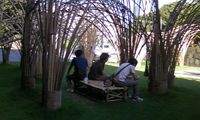
 展示室内をぐるっと見終わり、いつも彫刻が一つ置いてある芝生の前庭に出ると、そこには私の大好きな建築家、アトリエ・ワンの作品がありました。竹を使って人が集える場所を作ったとのこと。遠くから見ると、巨大な動物の輪郭に見えます。私の撮った写真には、3人の大学生らしき男の子たちが写っています。さっき仲良さげに展示室内を見て回っていた3人です。竹の間から真夏の日差しが降り注ぐ中、人が行き交うこの場所は、初めに入ってきた時に異空間に遭遇する驚きをもたらし、展示を見終わった後には私達を外部空間に導く緩衝地帯となっているところがとても好ましく思いました。


Where is architecture?

I have been to the exhibition called "Where is architecture? Seven Installations by Japanese Architects" at The National Museum of Modern Art, Tokyo. For me, an exhibition of architecture is tough to tackle with as same as one of fashion. I don't have any knowledge to read the drawing as it seems too technical for me, it is difficult to imagine the real size from the small models, and most of all, I always confuse how I should see the exhibits of architecture being dragged from the context where they are built. In this exhibition, the concept is that the seven noticeable Japanese architects to create new spaces for the museum. To be honest, some of them were "what on earth is that !?" for me, though, I recognised that the spaces are given meanings when there are live people. One of the reasons why I thought so was this. You were allowed to take photos in this exhibition (it is not very common in exhibition in Japan.). I felt it interesting to see the people walking and wondering in the building spaces through the lens of my mobile's camera. I was trying to capture those people in the photo, but when they found I was taking photos, they were politely moving out of the flame for me! So I said "No! don't move, stay there please!" in my mind! I wanted to see those spaces with people, because it makes me understand something that the architects were aiming at.
I looked through the exhibition rooms and went out to the front garden where there always was only a sculpture. There, there were huge works by Atelier Bow-wow that one of my most favourite architects unit. They made works of bending bamboo branches which looked like bones of a tent or a shelter. They said they tried to make where people could gather together. From the distance, they also looked like gigantic animal shapes. In the photo I took, there are three boys sitting together, who were looking around the exhibition rooms chatting. (I guesses they were architecture students.) This is the space where summer sun beam were coming through the bamboo and some people go by and some stay for a while. At first, it gave me a big surprise because there are only grass and a sculpture usually I visit. But, these pieces of work would have been a good effect of entering point when you go into the exhibition space like preparing your mind. And after you enjoy the exhibits, they, again, welcome to relax and let us go back to our everyday life.

2010年7月29日木曜日

メモワール

(English follows after Japanese)

 「古屋誠一メモワール.」展を見に行きました。とある内覧会の終盤、集まった人々の明るいお喋りの声を背後に聞きつつ、展示室に2人だけしかいないという静かな環境で作品を見ることができました。

 「メモワール」は20年近く続いているシリーズで、精神を病んで1985年に自死した作家の妻、クリスティーネが主な被写体になっています。この展覧会を見る前、ある美術館のショップでクリスティーネの手記が入った写真集を見つけ、冷房の利いた店内で1時間近く読みふけってしまったことがあります。他の人に理解されない孤独な恐怖や不安にさいなまれる彼女の苦悩が、胸に突き刺さるような思いになりました。展覧会は、クリスティーネの遺影から始まり、まだ小さい息子、成長した息子、共産主義の香りが色濃い東欧の風景、辛い顔つきになっていくクリスティーネ、メモワールシリーズの写真集、コンタクトシート、そして最後は若き日の笑顔のクリスティーネの写真で終わります。

 手記を読んだ後だったからか、最後のコーナーで逆回しのフィルムを見るような思いで、安堵と悲しみが同時にやってくるような気持ちになりました。もう辛くなくなってよかった、と私は思いました。自死は何も残さない、だから死んではいけない、という人の話を聞いたことがあります。しかしわたしはそうは思いませんでした。生と死の間を、らせん階段を上るように過ごしたクリスティーネの記録の断片と、それを残した作家の記憶をなぞるような体験から、その思いを新たにしました。色々な生があり、色々な死がある。どれも尊重すべきものだ、と私は信じたいと思ったのです。

"Mémoires."

I have been to Tokyo Metropolitan Museum of Photography to see the exhibition called "Seiichi Furuya Mémoires." It was a private view by some invited people from the supporters of the museum so that there are fewer people compared to usual opening days, which was so nice to concentrate on watching the exhibition.
"Mémoires." is the twenty-year series by the Japanese photographer Seiichi Furuya who has been based in eastern Europe. One of the major subjects was his wife, Christine, who suffered mental illness and died by herself in 1985. A few days before I saw this exhibition, I have been to the another art gallery and found Furuya's book with a diary of Christine in the shop. I have been reading her diary for almost one hour in that air-conditioned cold shop space. It was so painful that she wrote down again and again about her agony, fear, uneasiness and loneliness that anybody never understood. It was hard to hold my tears. Back to that exhibition, it starts from the shot of her portrait to commemorate her death, and followed by the mixture of the subjects like family, east European scenes where had some scent of Communism in 80s, and Christine which sometimes looked so unwell. In the last corner, there are some photo books of this "Mémoires." series and we also could have seen the contact sheets. (I haven't seen the contact sheets in many photo exhibitions, but I like it as it shows us how the artists see and trim the world much closer, by the way.) And at the very last part, the exhibition ends with a photo of Christine with smile on her face.
I felt sad but being released then. It was like watching the film rewinding. I suppose it was partly because I have read her diary, I really sympathised her even she chose death by herself, I found it calm to know that she never need to suffer anymore. Some people say suicide is sin and it leaves us nothing. But I didn't think so when I heard it. I convinced again when I saw this exhibition. The photos showed us the pieces of reality that Christine's life as if she has been going up the spiral staircase of balance of life and death. Mr. Furuya let us experience these "Mémoires” with Christine. Life and death are not all the same, everyone has everyone's life and death. They should be fully respected, I believed so from Mr. Furuya's works.